

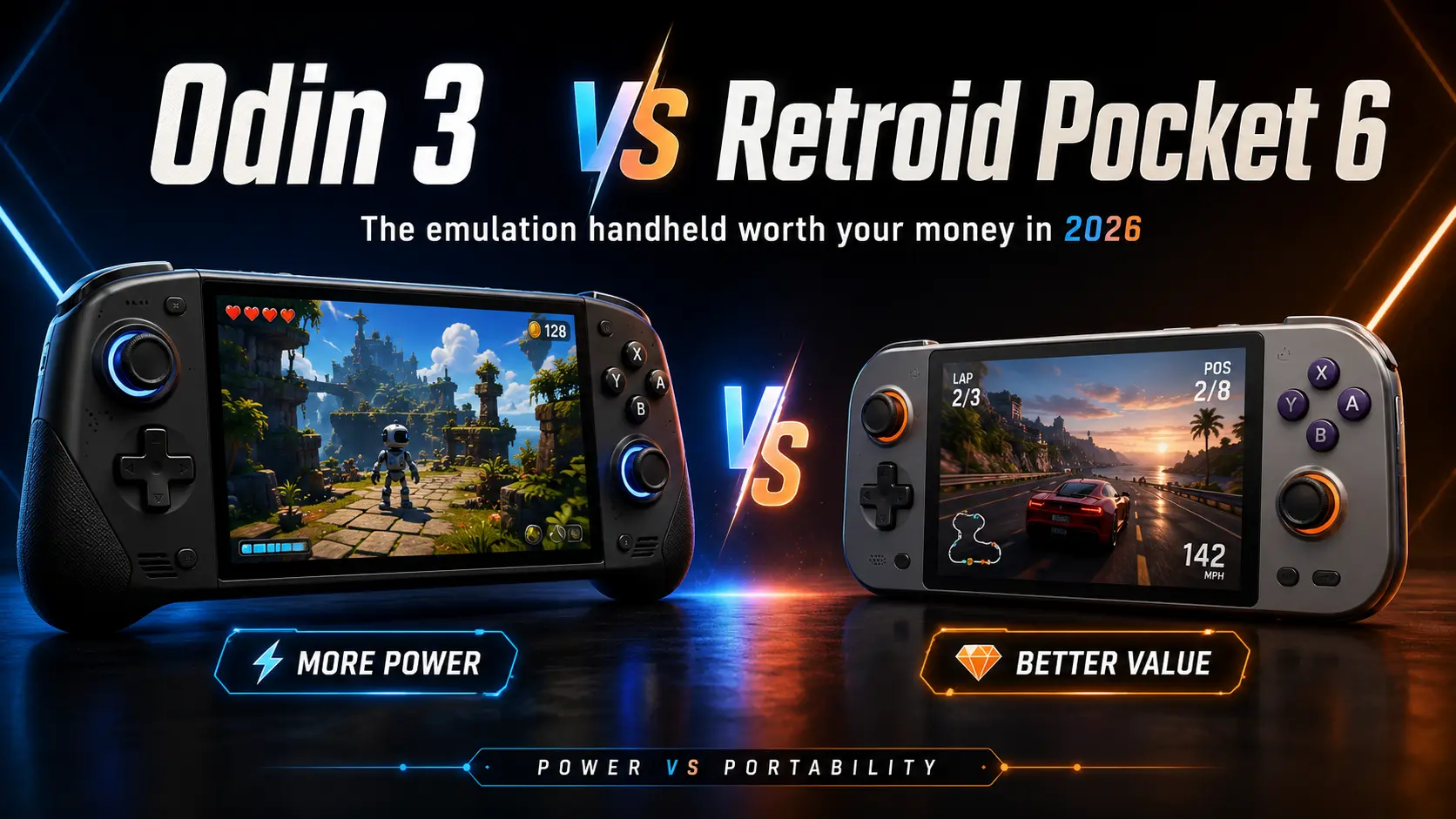
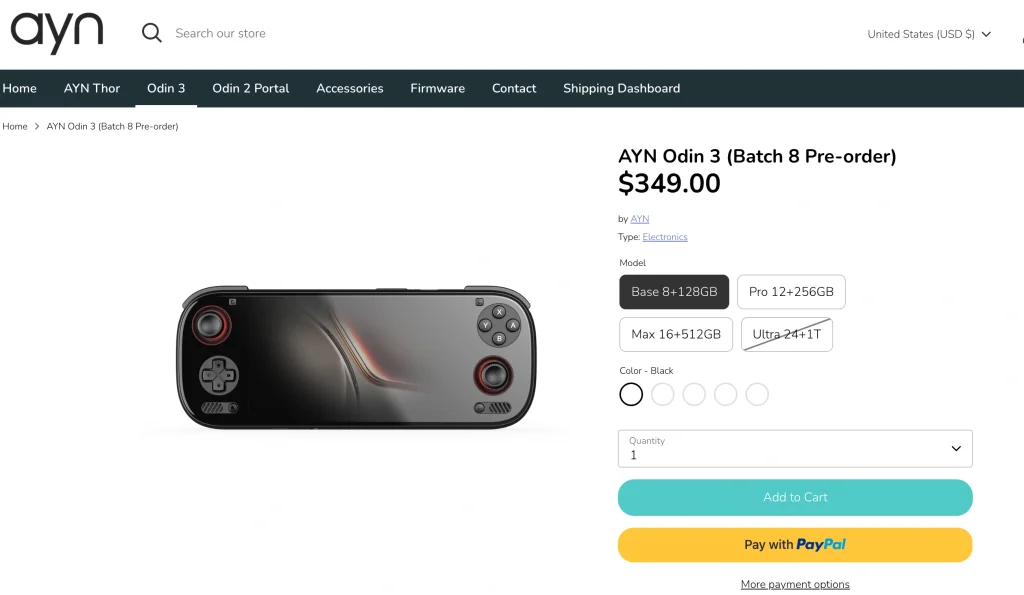
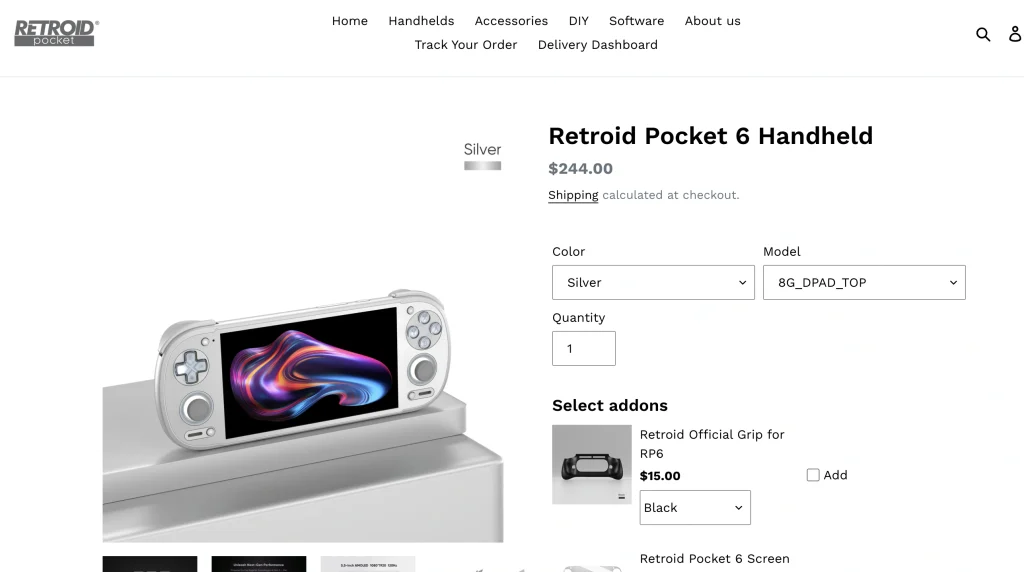
So you’ve narrowed it to two. On one side, the AYN Odin 3: a roughly $349 power flagship built around Qualcomm’s Dragonwing Q8, the handheld-tuned version of the Snapdragon 8 Elite. On the other, the Retroid Pocket 6: a roughly $244 value flagship running the older Snapdragon 8 Gen 2.
The Odin 3 wins nearly every spec line. Bigger battery, faster chip, newer Android, more RAM headroom. And for most of you reading this, that is exactly why it’s the wrong buy.
That’s the honest steer this whole piece is built around. Let me show you the math.
The verdict, before the deep dive
Neither wins outright – it depends on how high your emulation ceiling actually goes.
If your realistic ceiling is PlayStation 2 and GameCube (it is, for most people), the Retroid Pocket 6 gets you roughly 90% of the Odin 3 experience in a lighter, more pocketable body for about $100 less. The Odin 3 is the right call only if you specifically target Switch or PS3 emulation, want the biggest battery, or plan to dock to a TV often. Pay for the Dragonwing Q8 only if you’ll actually use it. Most people won’t.
Now the category-by-category breakdown, so you can argue with that verdict on the specifics.
Odin 3 and Retroid Pocket 6 at a glance
| Aspect | AYN Odin 3 | Retroid Pocket 6 |
|---|---|---|
| Chipset | Qualcomm Dragonwing Q8 (Snapdragon 8 Elite) | Snapdragon 8 Gen 2 |
| GPU | Adreno 830 | Adreno 740 |
| Screen | 6” AMOLED, 1920×1080, 120Hz | 5.5” AMOLED, 1920×1080, 120Hz, 550 nits |
| Battery | 8000 mAh | 6000 mAh |
| Charging | 60W | 27W |
| RAM/Storage (base) | 8GB/128GB, up to 24GB/1TB | 8GB/128GB, up to 12GB/256GB |
| OS | Android 15 | Android 13 |
| Weight | 390 g | 320 g |
| Price (mid-2026) | $349+ base | ~$244 base |
One’s the bigger, more powerful, more expensive machine. The other trims the spec sheet and the price tag. Where you land depends on the seven categories below.
Design, build and portability
The Odin 3 measures 224.8 × 87.5 × 16.6 mm and weighs 390 g. The Retroid Pocket 6 is smaller at 210 × 87 × 17 mm and 320 g. That 70-gram gap sounds trivial on paper. It isn’t after an hour-long session on the couch.
The Odin 3 earns its heft with Hall-effect sticks and a genuinely ergonomic grip – the kind of shell you forget you’re holding. The RP6 is the one that slips into a jacket pocket and comes on the train without a bag.
Now the downside nobody advertising the RP6 wants to lead with. Its launch was a mess. Retroid announced the Pocket 6 on October 27, 2025, then paused sales the very next day, October 28, after backlash over the D-pad and joystick layout – and put the redesign to a community poll. The final hardware landed fine, but that’s the sort of launch that should make you check exactly which revision you’re buying.
Screen: bigger canvas or sharper pocket
Both panels are 1920×1080 AMOLED running up to 120Hz, so both give you inky blacks and smooth scrolling menus. The difference is size and density.
The Odin 3’s 6” screen is the bigger canvas – better for docked-feeling handheld play and for tired eyes. The RP6’s 5.5” panel (rated 550 nits) packs those same 1080 pixels tighter, so it reads slightly sharper up close, and it’s the reason the whole device stays pocketable. Both handle 120Hz motion cleanly; you’ll notice the fluidity most in Android front-ends and native games rather than in a 60Hz PS2 title.
Call it a wash decided by preference: bigger and easier to read, or smaller and denser.
Performance: Snapdragon 8 Elite vs Snapdragon 8 Gen 2
Here’s the AYN Odin 3 review headline everyone fixates on. The Dragonwing Q8 (an Adreno 830 GPU paired with Oryon Prime cores running up to 4.32 GHz) is a full generation ahead of the Retroid Pocket 6’s Snapdragon 8 Gen 2 and its Adreno 740. On paper that’s a real, sometimes large, lead.
And here’s the part the spec sheet won’t tell you. Up to and including PlayStation 2, you will rarely feel that gap. Both chips run SNES, PSP, Dreamcast, GameCube and PS2 without breaking a sweat. The generational advantage only starts paying off where the workload gets genuinely brutal – Switch, PS3, and heavy native Android titles.
So yes, this is the more powerful Snapdragon 8 Gen 2 handheld’s successor versus the current flagship silicon. Just be honest with yourself about whether your library ever touches the ceiling that gap unlocks.
Emulation range: how far each one actually goes
This is the whole decision, so let’s be precise about the ceiling by console generation.
Both devices crush everything through PS2 and GameCube – clean, full speed, no fiddling. For context, the previous-generation Retroid Pocket 5 was already the device reviewers called good enough for most PS2 and GameCube games, and both machines here comfortably clear that bar. Engadget’s handheld roundup uses that RP5 baseline, which is a useful marker for just how far this tier jumped in 2026.
The Retroid Pocket 6 pushes to full-speed Switch emulation on a lot of titles, and manages PS3 with some compromises. The Odin 3 has more headroom in exactly those demanding spots – the tougher Switch games, the more ambitious PS3 attempts, and heavier native Android gaming. If your want-list is PS2, GameCube and everything below, both ceilings are effectively identical. If it’s Switch and PS3, the Odin 3’s extra muscle is the reason to pay.
Battery and charging
No contest here. The Odin 3 packs an 8000 mAh cell with 60W fast charging; the RP6 carries 6000 mAh and 27W.
The Odin 3 is the long-session, forget-the-charger device, and it tops back up fast. The RP6 is still respectable – you’ll get comfortable multi-hour GameCube and PS2 sessions out of it – but it’s the one you’ll reach for the cable sooner, and it charges slower when you do. If marathon play or infrequent charging matters to you, this category alone tilts toward the Odin 3.
Software, UI and connectivity
The Odin 3 ships on Android 15; the Retroid Pocket 6 launched on Android 13. Two versions matters less than it sounds for emulation itself, but the newer base does mean better long-term app compatibility and updates. Both carry Wi-Fi 7, both do USB-C video-out (the Odin 3 pushing up to 4K at 60Hz over DisplayPort Alt Mode), and both use a recent Bluetooth standard for pairing controllers and headsets.
Whichever you pick, the software reality is identical, and it’s worth saying plainly: neither is plug-and-play. You’re still living in Android launchers, RetroArch’s notoriously deep menus, and per-console control mapping. That’s the tax. More on it below.
Price and value, and the 2026 price-creep reality
Value is where the Retroid Pocket 6 review writes itself. It launched at $229 for the 8GB/128GB model and $279 for the 12GB/256GB tier. By mid-2026 the base sat around $244 – up about $15 – and the 12GB SKU had been pulled from guaranteed shipping entirely.
The Odin 3 has crept the other way. It launched at $329 for the base 8GB/128GB configuration and now sits at $349 and up at time of writing, with Pro, Max and Ultra tiers climbing toward $500-plus.
Why both moved: the 2026 DRAM and AI-memory price spike squeezed the whole tier, which is exactly what killed the RP6’s cheaper high-memory option and nudged the Odin 3 upward. The macro backdrop helps explain the pressure. Market researcher Icon Era’s 2026 tracking puts the retro and emulation handheld segment near 10% annual growth, outpacing the broader console market, with handhelds now over 30% of the overall gaming-console market. Demand is up, memory got expensive, prices followed. The practical takeaway is simpler: roughly a $100 gap on the base tiers, and the value crown stays firmly with the Retroid Pocket 6.
Who should buy which
No fake single winner here – this genuinely splits by use case.
Buy the Retroid Pocket 6 if: you’re most people. Your ceiling is PS2 and GameCube, you want the lightest, most pocketable body, and you want the best value in the best emulation handheld 2026 conversation. It gets you the vast majority of the experience for about $100 less.
Buy the AYN Odin 3 if: you specifically target Switch, PS3, or heavy native Android gaming, you want the biggest battery and the most RAM headroom, or you plan to dock to a TV often.
Skip the Odin 3 if: you’re paying for power you’ll never touch. Don’t buy a Dragonwing Q8 to play PS2.
Skip the Retroid Pocket 6 if: you know for a fact your library climbs above Switch, or you want the bigger 6” screen and the 8000 mAh battery more than you want the savings.
Wrap Up
Back to where we started: in the Odin 3 vs Retroid Pocket 6 decision, the more powerful device is the wrong buy for most people. The Retroid Pocket 6 is the smarter pick for the majority – lighter, cheaper, and functionally identical up to the PS2/GameCube ceiling where most emulation libraries actually live. The AYN Odin 3 is the right call for the power-user minority chasing Switch, PS3, native Android, or maximum battery.
One reality check before you buy either, because it applies equally to both. Emulation on these handhelds is not plug-and-play. You’re sourcing games, matching each console to the right emulator, mapping controls per system, and wrestling RetroArch’s menu maze. Both machines reward patience, not impatience – budget the setup time before you budget the money.
For more verdicts like this one, our reviews and gear coverage tracks the handhelds, consoles and gadgets worth your money.
Frequently asked questions
Can the Retroid Pocket 6 run Switch and GameCube games?
Yes to both. The Retroid Pocket 6’s Snapdragon 8 Gen 2 runs GameCube cleanly and pushes to full-speed Switch emulation on many titles, with PS3 possible under some compromises. GameCube is effortless; Switch performance varies by game, so the more demanding releases can still stutter without tuning.
Is the AYN Odin 3 worth the extra money over the Retroid Pocket 6?
Only for a specific buyer. The Odin 3 costs about $100 more and wins nearly every spec, but up to PS2 and GameCube you won’t feel it. It’s worth the premium if you target Switch, PS3, or native Android gaming, or want the 8000 mAh battery. Otherwise, save the money.
Is the Snapdragon 8 Elite really better than the Snapdragon 8 Gen 2 for emulation?
Yes, it’s a full generation ahead, and the lead is large in some tests. But it only matters at the top of the range – Switch, PS3, and heavy native games. For everything through PlayStation 2 and GameCube, both chips deliver effectively the same, smooth experience.
How much do the Odin 3 and Retroid Pocket 6 cost in 2026?
At time of writing, the AYN Odin 3 starts around $349 for the base 8GB/128GB model, with higher tiers climbing toward $500-plus. The Retroid Pocket 6 sits near $244 for its 8GB/128GB base after a 2026 memory-driven price bump that also pulled its 12GB configuration from guaranteed shipping.
Is emulation on these handhelds hard to set up?
It takes patience. As Engadget notes in its handheld guide, you’re securing your own game files, installing the right emulator per console, mapping controls, and navigating RetroArch’s deep menus – and some games simply won’t run right. Neither device is plug-and-play, so budget the setup time before you buy.
Which has better battery life?
The AYN Odin 3, clearly. Its 8000 mAh cell with 60W charging outlasts and outcharges the Retroid Pocket 6’s 6000 mAh battery and 27W charging. The RP6 still handles comfortable multi-hour GameCube and PS2 sessions, but the Odin 3 is the one built for marathons and quick top-ups.