
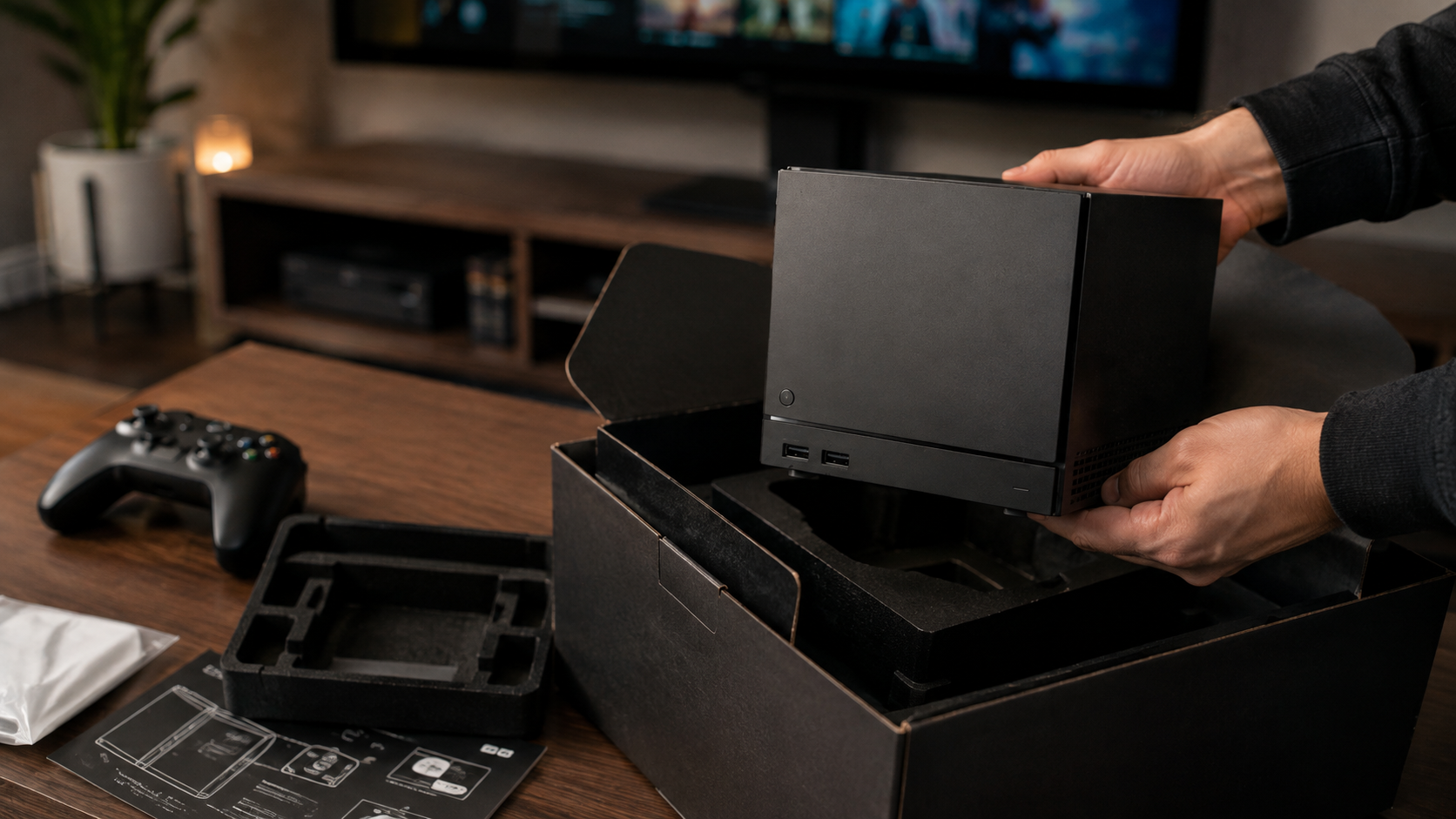

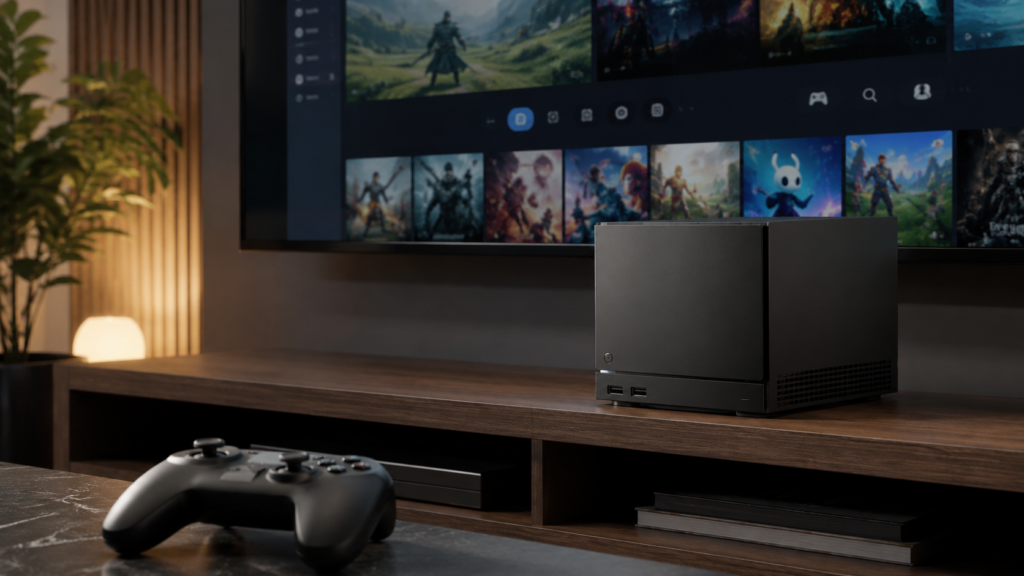
It’s been sitting under my TV for a month now, and the first thing I still notice is what I don’t notice: it’s silent. A matte-black cube about the size of a hardback book, humming along at a whisper while it runs Kingdom Come: Deliverance II on the couch. As living-room hardware goes, it’s the tidiest thing Valve has ever shipped.
The problem this steam machine review has to answer isn’t whether it’s nicely built. It is. The problem is the price tag. At $1,049 for the 512GB model, you’re paying console money plus a healthy tip, and that forces an awkward question: is this a console you buy instead of a PS5, or a compact gaming PC you could just build cheaper yourself?
Having lived with it, I land somewhere in the middle – and not in the flattering way you’d hope.
The verdict, up front
The Steam Machine is a beautifully engineered, near-silent living-room PC running the most mature version of SteamOS to date. It’s genuinely lovely to use. But under the hood it’s an RX 7600-class, 1080p machine wearing a “4K 60” marketing coat, and at $1,049 the value math is hard to defend.
Buy it if you want the neatest, quietest couch PC money can buy and you value the plug-and-play SteamOS experience and your full Steam library over raw price-to-performance. Skip it if you already own a gaming PC, you actually want 4K, or you just want the cheapest way to game on your TV – a PS5 does that for around $400 less. It’s not a console alternative. It’s a compact PC, and it should be judged as one.
What the Steam Machine actually is
Let’s kill the biggest misconception first: this isn’t a locked-down console. It’s a small-form-factor PC running SteamOS 3, Valve’s Arch-based, KDE Plasma operating system – the same lineage that powers the Steam Deck. You can install Windows on it. You can use it as a desktop. It just happens to boot straight into a controller-friendly Big Picture home screen so it behaves like a console when you want it to.
Valve pitches it as roughly six times the power of the Steam Deck, and the spec gap backs that up – 28 GPU compute units here versus the Deck’s 8. It’s the same idea scaled up for the TV instead of your hands.
The software story is the part that’s aged well over the month. Valve’s Steam Machine Verified programme means 25,000-plus games are expected to run day one, at a minimum bar of 1080p/30fps with full controller support. In practice the “just works” rate has been high – you buy a game, it downloads, it runs. That’s a real shift from the old Steam Machine era, and it’s the strongest thing this box has going for it.
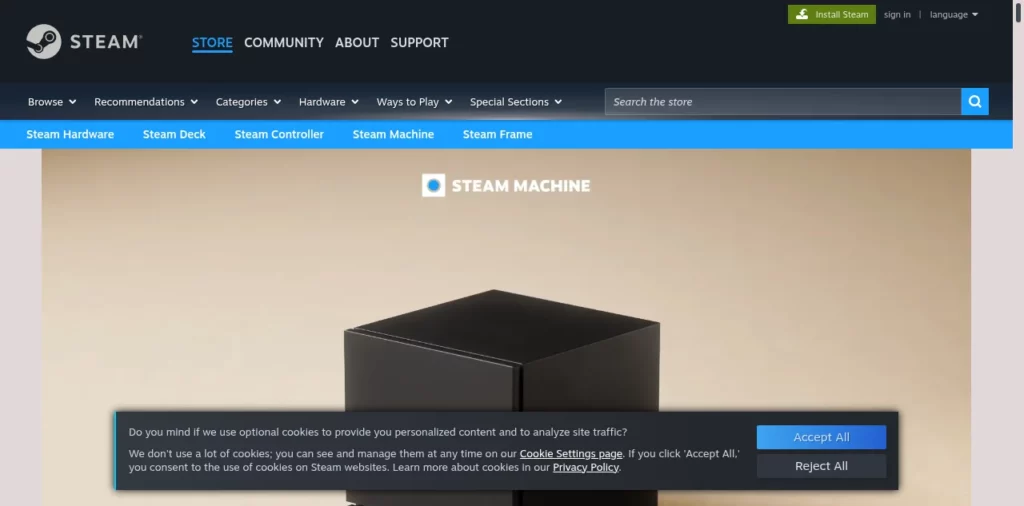
Steam Machine official product page
If you want a sense of what’s actually worth loading onto it this year, our rundown of the games worth buying day one in 2026 is a good place to start.
Steam Machine specs – what’s inside, and where the ceiling is
Here’s the part that decides everything. The Steam Machine specs read well on paper and reveal their limits the moment you push them.
| Component | Steam Machine | Notes |
|---|---|---|
| CPU | Semi-custom AMD Zen 4, 6C/12T, up to 4.8GHz, 30W TDP | 30W ceiling throttles it hard under load |
| GPU | AMD RDNA 3, 28 CUs @ 2.45GHz, 110W | Roughly mobile RX 7600 class |
| VRAM | 8GB GDDR6 | The real bottleneck on modern games |
| RAM | 16GB DDR5-5600 | Fine for gaming |
| Storage | 512GB or 2TB NVMe SSD + microSD slot | Two price tiers |
| OS | SteamOS 3 (Arch-based, KDE Plasma) | Open – installs Windows too |
| Size / weight | ~152 x 156 x 162mm, 2.6kg | Genuinely tiny |
Two numbers matter more than the rest. The first is that 8GB of VRAM – in 2026 a real ceiling, since plenty of modern games eat more than 8GB at higher settings, and when they hit the wall you get texture pop-in and stutter rather than clean frames. The second is the 30W CPU, a power budget more at home in a handheld. Testing from GamersNexus found it throttling to roughly Zen 2-era real-world performance under sustained load, landing near a Ryzen 5 5600X in Blender. The GPU is the star; the CPU is along for the ride.
None of this makes it bad. It makes it honest about what it is – a capable 1080p machine – and dishonest about what it’s marketed as.
A month of living with it – performance, noise, and the 4K asterisk
So how does it actually feel to game on? Quiet. Genuinely, remarkably quiet. Independent noise testing from GamersNexus clocked it at 20-21 dBA under a gaming load and 23-24 dBA in a torture test at 1252 RPM, with idle effectively inaudible. I can confirm the lived experience matches: in a normal living room, you will not hear this thing over the show your partner is half-watching next to you. For couch gaming, that alone is worth something.
Performance is where the marketing and reality part ways. Valve leans on “4K 60” via FSR upscaling. The honest ceiling for demanding titles is 1080p. GamersNexus’s real numbers tell the story cleanly: Black Myth: Wukong at High managed 43.9fps, Starfield on Ultra sat at 41fps, Kingdom Come: Deliverance II on Ultra hit 50fps. Lighter or better-optimised games fly – Resident Evil 4 on Graphics Priority ran at 94fps. Read that as: a well-optimised game will feel great; a heavy 2026 release will have you dropping to 1080p and reaching for FSR.
The one thing that still bugs me a month in is SteamOS itself. It’s excellent, but it was born on a handheld, and you can feel it. The home screen is console-slick, but drop into desktop mode or wrestle with a niche launcher and the handheld-first roots show. It’s a small friction, not a dealbreaker – but if you’re expecting the polish of a PS5’s system UI, adjust your expectations.
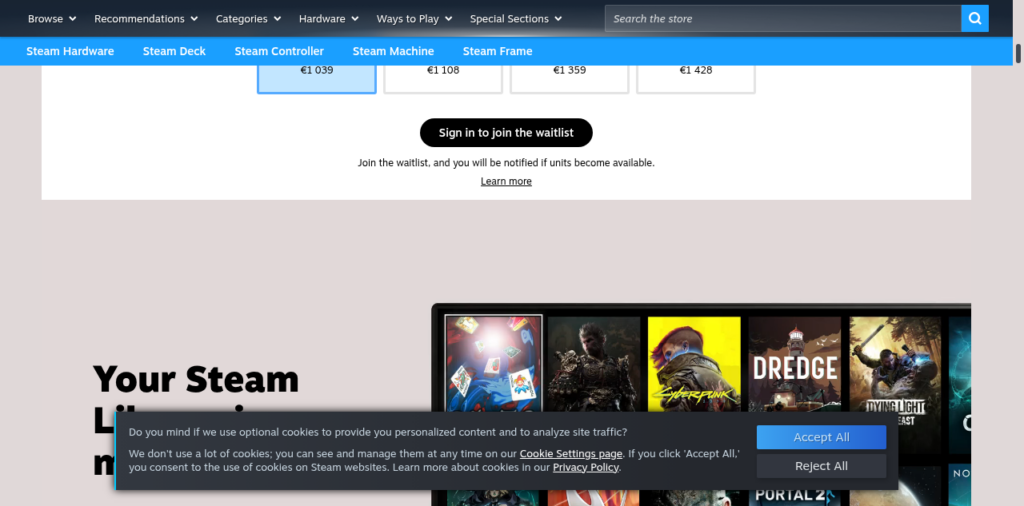
SteamOS Steam Machine interface
Steam Machine vs building your own PC at the same budget
This is the comparison that keeps the value question awake at night, and the steam machine vs pc math is unforgiving.
Build a comparable box today and you land around $1,150: a Ryzen 5 7600X at roughly $199, an RTX 5060 Ti 16GB at about $400, a B650 board near $140, 16GB of DDR5 around $205, a 1TB NVMe at $145, a 650W PSU for $70, and a case for $70. That’s about a hundred dollars more than the Steam Machine’s 512GB tier – and for that hundred you get double the VRAM, a meaningfully stronger GPU, a CPU that isn’t power-limited, and a machine you can upgrade one part at a time. Go the AM4/DDR4 route with a Ryzen 5 5600 and the same GPU class, and a capable build dips under $1,000.
GamersNexus put it bluntly: “You could put together a box that would perform better than the Steam Machine in terms of FPS for the same amount of money or less.” Their accounting pegged the 512GB model at a $71 (7.3%) premium over a comparable DIY build, and the 2TB model at a $211 (18.5%) premium.
| Aspect | Steam Machine ($1,049) | DIY PC (~$1,150, or <$1,000 on AM4) |
|---|---|---|
| Raw performance | RX 7600 class, 8GB VRAM | Faster GPU, 16GB VRAM, full-power CPU |
| Size / silence | Tiny, near-silent | Bigger, noisier unless you tune it |
| Setup | Plug in and play | You build it and troubleshoot it |
| Upgradeable | Effectively no | Yes, part by part |
| OS experience | SteamOS, console-simple | Windows/Linux, your problem to manage |
So who wins? Neither outright – it depends on what you’re actually buying. If you want the most frames per dollar and a machine that grows with you, build the PC. If you want a silent, hand-sized box that needs zero assembly and boots like a console, the Steam Machine earns its small premium. You’re paying for the engineering and the convenience, not the performance.
Steam Machine vs PS5 and Xbox – price and power
Now the comparison most buyers actually care about, because a TV and a couch is exactly where consoles live. The steam machine vs ps5 xbox question comes down to openness versus price.
On price, the consoles win, but the gap is narrowing thanks to a rough year for hardware costs. A disc PS5 now runs $649.99 after its April 2026 hike (the digital edition is $599.99, the PS5 Pro is $899.99). The Xbox Series X is climbing to $799.99 on August 1, 2026, up from $649.99, with Microsoft citing console storage and memory prices rising “more than 2.5x.” Even so, a PS5 lands well under the Steam Machine’s $1,049.
On raw graphics, the Steam Machine’s RDNA 3 GPU is the more modern part, but the consoles are no pushovers – the Xbox Series X pushes 12 TFLOPS across 52 CUs, the PS5 sits at 10.28 TFLOPS, and both carry Zen 2 CPUs with 16GB of GDDR6. The consoles also enjoy years of console-specific optimisation and, tellingly, a vast subsidised install base – roughly 91 million PS5s against about 34 million Xbox Series X|S units.
| Aspect | Steam Machine | PS5 / Xbox Series X |
|---|---|---|
| Price | $1,049 | PS5 $649.99 / Xbox $799.99 (Aug 1) |
| GPU | RDNA 3, 28 CUs | RDNA 2 – 12 TFLOPS (Xbox) / 10.28 (PS5) |
| Library | 25,000+ Steam games | Exclusives + curated store |
| Openness | Full PC, installs Windows | Locked ecosystem |
| Optimisation | Broad, less console-tuned | Deep, console-specific |
Fake binary refused: neither is “better.” A PS5 is the cheaper, simpler, exclusive-driven path onto your TV, and for most people wanting a couch box it’s the smarter buy. The Steam Machine only makes sense if what you actually want is your open Steam library, PC-style freedom, and the option to tinker – and you’re willing to pay a real premium for it.
Who should buy it – and who should skip it
Buy the Steam Machine if you want the tidiest, quietest couch PC that exists, you’re bought into SteamOS and your existing Steam library, and the plug-and-play simplicity is worth the price to you. IGN’s Jacqueline Thomas called it “the best living room PC I’ve ever used, despite being a bit weaker than either of the base consoles,” and if that’s the machine you’ve been waiting for, it delivers.
Skip it if any of these are you: you already own a gaming PC (this is a sidegrade at best), you genuinely want 4K (you’ll be at 1080p on anything demanding), you want the cheapest route to your TV (buy a PS5), or you’d rather have more performance for the same money (build the box). PC Gamer’s Andy Edser reached the honest end of that logic – “despite the little black box’s lovely design, excellent controller, and sheer curiosity value, the answer is no.”
If you’re weighing this against other 2026 hardware and doing the buy-now-or-wait dance, our buyer’s-guide take on the year’s smart glasses runs the same decision framework on a different device.
Wrap up
A month in, the cube is still under my TV, still silent, still a pleasure to switch on. That’s the Steam Machine in a sentence: a lovely piece of living-room engineering that does exactly what it says. What it doesn’t do is win the value argument. This steam machine review lands on a clear split – it’s a genuinely great compact PC and a genuinely poor deal against both a DIY build and a PS5.
The short version: buy it if silence, size, and a plug-and-play SteamOS couch experience matter more to you than frames-per-dollar. Skip it if you own a gaming PC, want true 4K, want the cheapest TV gaming, or would rather build for the money. Reality check either way: it’s an RX 7600-class 1080p machine at a $1,049 price – great hardware, awkward math.
If Valve trims the price or ships a beefier tier down the line, this recommendation moves fast. For now, go in knowing what you’re buying: convenience and craft, not value. Want more calls like this one? Browse the rest of our game and device reviews before you spend.
Frequently asked questions
How much does the Steam Machine cost?
The Steam Machine starts at $1,049 for the 512GB model and $1,349 for the 2TB version. A 2TB bundle with the controller and faceplates runs $1,428. That puts the entry price well above current consoles and roughly in line with a comparable DIY gaming PC.
Can the Steam Machine run 4K?
Not really, despite the “4K 60” marketing. It hits that only in lighter games or by leaning on FSR upscaling. For demanding 2026 titles the realistic target is 1080p – Black Myth: Wukong managed 43.9fps and Starfield 41fps at 1080p in independent testing. Treat it as a strong 1080p machine, not a 4K one.
Is it cheaper to build a PC than buy a Steam Machine?
Yes, marginally, and you get more for the money. A comparable DIY build lands around $1,150 – about $100 more than the 512GB Steam Machine – but with double the VRAM, a stronger GPU, and upgradeability. Go AM4/DDR4 and a capable build drops under $1,000. You trade away the tiny size and silence.
Steam Machine vs PS5 – which should I buy?
Buy a PS5 if you want the cheapest, simplest way onto your TV – it’s around $400 less at $649.99 and exclusive-driven. Choose the Steam Machine if you want your open Steam library, PC freedom, and the option to install Windows, and you’ll pay a real premium for that flexibility.
Can you install Windows on the Steam Machine?
Yes. Unlike a locked console, the Steam Machine is an open PC. It ships with SteamOS 3, but you can install Windows or another operating system on it and use it as a standard desktop. That openness is one of its genuine advantages over a PS5 or Xbox.
Is the Steam Machine quiet?
Very. Independent testing measured it at 20-21 dBA under a gaming load and 23-24 dBA in a torture test, with idle noise effectively inaudible. In a normal living room you won’t hear it over the TV. Near-silent operation is one of the machine’s standout, genuinely lived-in strengths.
When did the Steam Machine release?
It launched around June 29-30, 2026, after being announced in November 2025. Availability is managed through a reservation draw, and that queue is expected to run through 2026 – so getting one may still mean joining a waiting list rather than buying instantly off the shelf.