

Here’s how the search for the best 4K Blu-ray player usually ends in 2026. You read four buying guides, they all point at the same Panasonic, you click through to Panasonic’s own store, and the button says Sold out. Price still listed: $549.99. That was the state of the DP-UB820-K page when we checked it on August 17, 2026.
Meanwhile the discs themselves are doing fine. Better than fine, actually. US 4K Blu-ray sales grew 12% in 2025 over 2024 according to the Digital Entertainment Group’s year-end figures, and the UK 4K UHD market grew 19.5% in 2025 on the Entertainment Retailers Association’s numbers. Demand is up. Supply is thinning out.
So the honest answer to “which 4K Blu-ray player should I buy” is not a single model. It’s a set of use-case picks, plus a genuinely important caveat: a lot of you already own a player and don’t need to spend anything. We’ll get to who that is.
The TL;DR verdict
No single winner, and anyone handing you one is either ignoring stock levels or ignoring your TV. The Panasonic DP-UB820-K is still the best 4K Blu-ray player on merit because it covers every HDR format that matters, and it’s also the hardest one to actually buy. The Sony UBP-X700 is the value pick and the one most people should get. Your console is probably good enough if your TV is HDR10-only. And nobody needs a sub-$250 player if they own a Dolby Vision TV.
- Get the Panasonic DP-UB820-K if your TV does Dolby Vision or HDR10+, you want HDR Optimizer tone mapping and a separate audio-only HDMI out, and you’re willing to hunt stock at $549.99 list.
- Get the Sony UBP-X700 if you want Dolby Vision on a budget. Street prices have been running roughly $160 to $190 new as of August 2026, and it’s the easiest of the lot to find.
- Get the Panasonic DP-UB154P-K if your TV is HDR10 or HDR10+ and you just want discs to play properly for $239.99. It has no Dolby Vision. That’s the trade.
- Get a Magnetar if you’re running balanced XLR outputs into a two-channel rig and you play SACDs. Roughly $1,800 to $1,900 at US dealers, and you already know if this is you.
- Buy nothing if you own a disc-drive PS5 or Xbox Series X and your TV isn’t Dolby Vision-capable. Seriously. Skip to the “skip it” section.
Every price and stock figure in this piece is a snapshot taken in August 2026. In this category especially, treat them that way.
The 2026 4K Blu-ray player comparison, at a glance
| Player | Price (Aug 2026) | Dolby Vision | HDR10+ | Availability | Best for |
|---|---|---|---|---|---|
| Panasonic DP-UB820-K | $549.99 list | Yes | Yes | Sold out on Panasonic’s own store | Enthusiasts with a DV or HDR10+ TV |
| Panasonic DP-UB154P-K | $239.99 | No | Yes | In stock | Budget buyers on HDR10/HDR10+ TVs |
| Sony UBP-X700 | ~$160-$190 street | Yes | No | Widely available, new and used | Best all-round value |
| Magnetar UDP800 / UDP800 MKII | ~$1,800-$1,900 at dealers | Yes | Yes | Dealer and boutique only | Audiophiles, SACD, XLR out |
| PS5 (disc edition) | $649.99 | No | No | Widely available | People who already own one |
| Xbox Series X (1TB, disc) | Up $150 since Aug 1, 2026 | Games and apps only, not discs | No | Widely available | People who already own one |
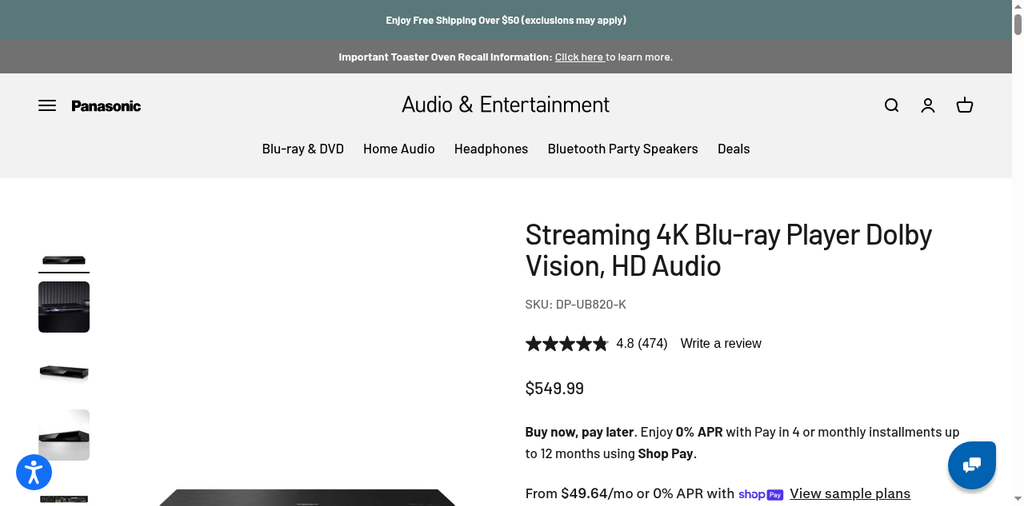
Panasonic DP-UB820-K product page
That table is the whole article in six rows, and the most important column isn’t price. It’s availability. A player you can’t buy is not a recommendation, no matter how many “best of” lists put it at number one.
Why discs came back, and why it isn’t nostalgia
The vinyl comparison gets made constantly and it’s mostly wrong. Vinyl came back on feel and ritual. Discs came back on a much colder argument: the thing you paid for on a streaming service can be taken away, and the thing on your shelf can’t.
The numbers
The Digital Entertainment Group’s 2025 data put total US physical media sales at $870 million, down 9.3% year on year. That sounds bad until you look at the previous year, when the same category fell 23.4%. The slide is flattening. And inside that shrinking total, 4K Blu-ray specifically grew 12%.
The UK picture is stronger. ERA recorded 19.5% growth in the 4K UHD market across 2025. Roughly one in ten 4K releases shipped with a steelbook edition, and those steelbooks accounted for nearly £2 of every £10 spent on the format. The year’s best-selling disc was Wicked. People aren’t buying discs to be difficult; they’re buying objects with artwork on them.
The licensing problem
Now the cold part. PlayStation’s own legal page for PS Video content states that “from September 1, 2026, due to our content licensing agreements, you will no longer be able to access your previously purchased content from Studio Canal, and it will be removed from your video library.” You can read PlayStation’s own notice on purchased video content yourself.
Read that again with the word “purchased” in mind. Money changed hands, a licence expired, and the title leaves the library. A disc has no expiry clause. That single asymmetry explains more of the 2026 disc revival than any amount of audiophile enthusiasm, and it’s the same argument we made when we looked at tracking what you actually own across services.
The bitrate gap
The technical case holds up too, and it’s worth stating in numbers rather than adjectives. Ultra HD Blu-ray is 3840×2160 at up to 60 progressive frames per second, encoded in H.265/HEVC. The format’s disc tiers run 50 GB at 72 or 92 Mbit/s, and 66 GB and 100 GB at 92, 123 or 144 Mbit/s.
No consumer streaming tier comes close to 144 Mbit/s. That gap is where film grain survives, where dark scenes stop blocking up, and where the difference is genuinely visible rather than imagined. The format has been shipping in the US since February 14, 2016, so this is not new technology finding its feet. It’s mature technology being quietly starved.
Is 4K Blu-ray worth it in 2026? The honest answer
Yes, if you watch fewer things more carefully. No, if you watch a lot of things once.
That’s the real dividing line, and it has nothing to do with picture quality. A disc costs $20 to $35 and gives you one film forever, at a bitrate no service will match, with the lossless Dolby TrueHD or DTS-HD Master Audio track that streaming platforms almost never carry. If you rewatch Blade Runner 2049 twice a year and want it to look right both times, the maths works.
If your viewing is “whatever’s on tonight”, it doesn’t. Six discs a year plus a $550 player is an expensive way to be a casual viewer, and we’d rather tell you that than sell you a box.
There’s an edge case worth naming: physical collectors who buy boutique-label releases. Those editions frequently carry restorations and extras that never appear on any service, and they go out of print. For that reader the player isn’t optional, and the “is it worth it” question was answered years ago.
Will 4K Blu-ray go obsolete? The supply side nobody wants to write about
Here’s the collision at the centre of this article. Demand is measurably rising. The hardware to serve it is measurably disappearing.
Samsung and Oppo both exited the UHD player market between 2017 and 2019. LG has since discontinued its entire 4K Blu-ray player range; its last models, the UBK80 and UBK90, date to 2018. That leaves Panasonic and Sony as the only mainstream manufacturers still shipping standalone Ultra HD Blu-ray players in 2026, with boutique brands like Magnetar filling the top end.
The contraction runs beyond players. Panasonic is now the last supplier of Blu-ray recorders and has publicly apologised for order backlogs after rivals left the category. Different product, same signal.
So: will the format go obsolete? Not through lack of demand, and not soon. Discs already in print will play on the players already in homes for a decade or more. But “the format survives” and “you can walk into a shop and buy a new flagship player” are two different claims, and only the first one is comfortably true right now. Buy accordingly.
The HDR mess: what a UHD player with Dolby Vision actually buys you
This is the section most buying guides skim, and it’s the one that decides whether you’re happy with your purchase.
The Ultra HD Blu-ray specification makes HDR10 support mandatory and Dolby Vision support optional. HDR10+ and SL-HDR2 were added as further optional formats in January 2018. That one word, “optional”, is why a $239.99 player and a $549.99 player can both be legitimately spec-compliant while behaving completely differently on the same disc.
Worth knowing how theoretical “optional” can get: no Ultra HD Blu-ray player has ever supported SL-HDR2, and no discs were ever released encoded in it. A format can sit in the spec sheet and never exist in the world. Treat box logos accordingly.
What each format actually does for you
HDR10 is the baseline: static metadata, present on every UHD disc and every UHD player, so nobody is locked out of anything here. Dolby Vision uses dynamic, scene-by-scene metadata instead, and on a capable OLED or high-end LED TV the difference on dark, high-contrast material is real. On a mid-range HDR10-only set it’s worth exactly nothing. HDR10+ is the royalty-free dynamic alternative, common on Panasonic and Samsung TVs but scarcer on discs than Dolby Vision. HLG is broadcast-focused, supported by most modern players, and rarely the reason anyone picks one.
The rule that actually matters
Match the player to your TV, not to your budget. A Dolby Vision TV plus a player without Dolby Vision equals HDR10 playback, which means the DP-UB154P-K is the wrong purchase for a Dolby Vision LG OLED even though it’s the cheapest new player Panasonic sells. Spend the extra and get the Sony UBP-X700 instead. Conversely, if your TV is HDR10-only, paying $550 for Dolby Vision support buys you a feature your display will never use.
Panasonic vs Sony: the two mainstream options
| Aspect | Panasonic DP-UB820-K | Sony UBP-X700 |
|---|---|---|
| HDR coverage | HDR10, HDR10+, HLG, Dolby Vision | HDR10, Dolby Vision (no HDR10+) |
| Processing | HCX processor, HDR Optimizer, 4K Direct Chroma Upscaling | HDR-to-SDR conversion, standard upscaling |
| Outputs | Twin HDMI (one audio-only), 7.1ch analogue, optical digital | Dual HDMI, coaxial digital |
| Audio | Dolby TrueHD, DTS-HD Master Audio, Dolby Atmos and DTS:X bitstream | Dolby Atmos and DTS:X bitstream, Hi-Res Audio |
| Region behaviour | US units region-locked (BD Region A, DVD Region 1) | Region-locked as sold |
| Price (Aug 2026) | $549.99 list | ~$160-$190 street |
| Availability | Sold out on Panasonic’s store | Widely available |
Panasonic DP-UB820-K, the good: it’s the only player on this list under $600 that covers all four HDR formats. HDR Optimizer genuinely helps on TVs with modest peak brightness, because it tone-maps to your display rather than dumping the disc’s metadata and hoping. The separate audio-only HDMI output matters if you’re feeding an older AV receiver that can’t pass 4K HDR video cleanly. Dual USB, wired and wireless networking, proper 7.1 analogue outs for legacy amps.
Panasonic DP-UB820-K, the bad: stock. As of August 2026 Panasonic’s own store lists it at $549.99 with a Sold out button, which pushes you to third-party sellers and their pricing. The US units are region-locked, so imported discs need a third-party modified unit. And $549.99 is a lot of money for a transport in a category that keeps shrinking.
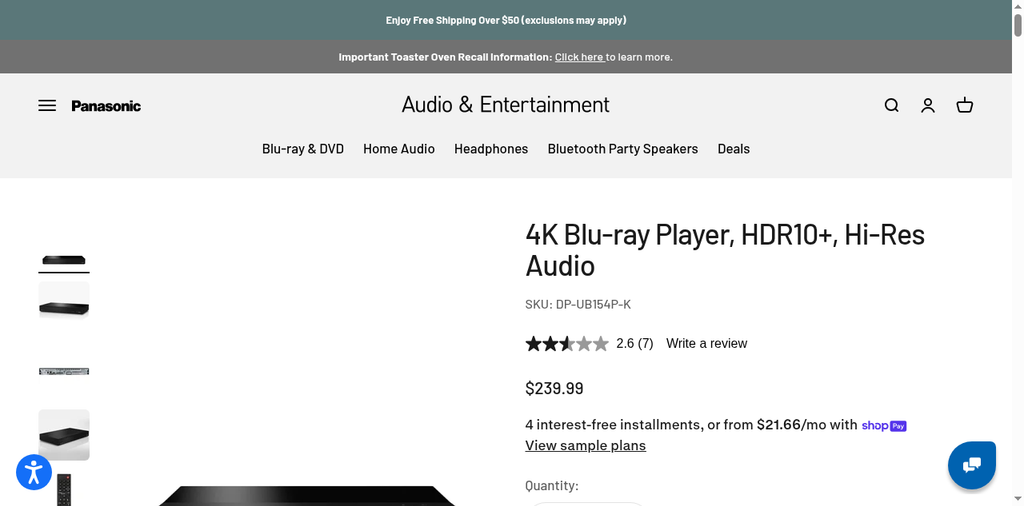
Panasonic DP-UB154P-K product page
Sony UBP-X700, the good: Dolby Vision and HDR10 for roughly a third of the Panasonic’s list price, plus dual HDMI and full Atmos and DTS:X bitstreaming. It’s been on the market long enough that used units turn up cheap and stock is not a problem. For most people reading this, it is the correct answer and the rest of the article is context.
Sony UBP-X700, the bad: no HDR10+, which stings if you own a Panasonic or Samsung TV built around that format. The interface is dated and slow to load discs compared with the Panasonic. There’s no HDR Optimizer equivalent, so tone mapping on a dimmer TV is less refined. Sony’s step-up model with SACD support has become harder to find at retail.
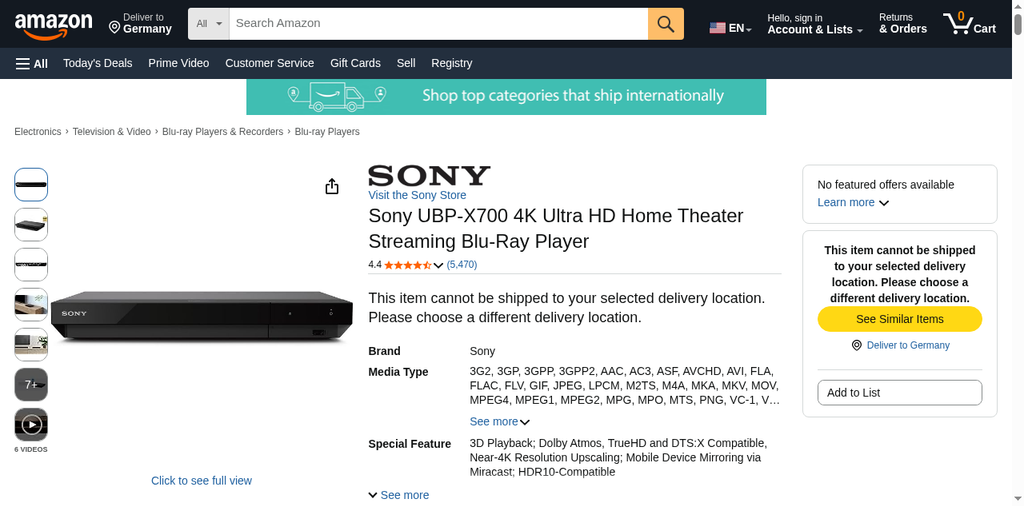
Sony UBP-X700 retail listing
Is your console already good enough? PS5 and Xbox Series X as disc players
Both play Ultra HD Blu-ray. The format’s own device list names the PS5 (non-Digital), Xbox Series X, Xbox One X and Xbox One S (non-All-Digital) as playback hardware. If you own one of those with a disc drive, you own a 4K Blu-ray player.
Now the catch nobody puts on the box.
The PS5 has no Dolby Vision support at all. Not for games, not for apps, and not for discs. The Xbox Series X does support Dolby Vision for games and streaming apps, but it drops to HDR10 for UHD Blu-ray playback. So the two most common 4K Blu-ray players in the world will not play a Dolby Vision disc in Dolby Vision. Neither supports HDR10+ either. If you own a Dolby Vision TV and you’re feeding it discs through a console, you are watching HDR10 and you may never have known.
And they stopped being the cheap option
The “just use your console” argument used to include a price advantage. It doesn’t any more. The disc-drive PS5 has been $649.99 in the US since April 2, 2026, up from $549.99, with the Digital Edition at $599.99 and the PS5 Pro at $899.99. On the other side, Xbox confirmed a worldwide price increase of US$100 for 512 GB models and US$150 for 1 TB models effective August 1, 2026, with the 2 TB model discontinued. Trade reporting puts the 1 TB disc Series X near the $800 mark after that rise.
Buying a $650 console to play discs is now more expensive than buying the Panasonic that plays them better. If you want the wider picture on where console economics went this year, we broke down the 2026 console subscription price shake-up separately.
There’s an irony here worth sitting with. The PlayStation that plays your discs beautifully is the same platform removing purchased Studio Canal titles from libraries on September 1, 2026. One drive gives you permanence; one store takes it away.
The high end and the boutique escape hatch
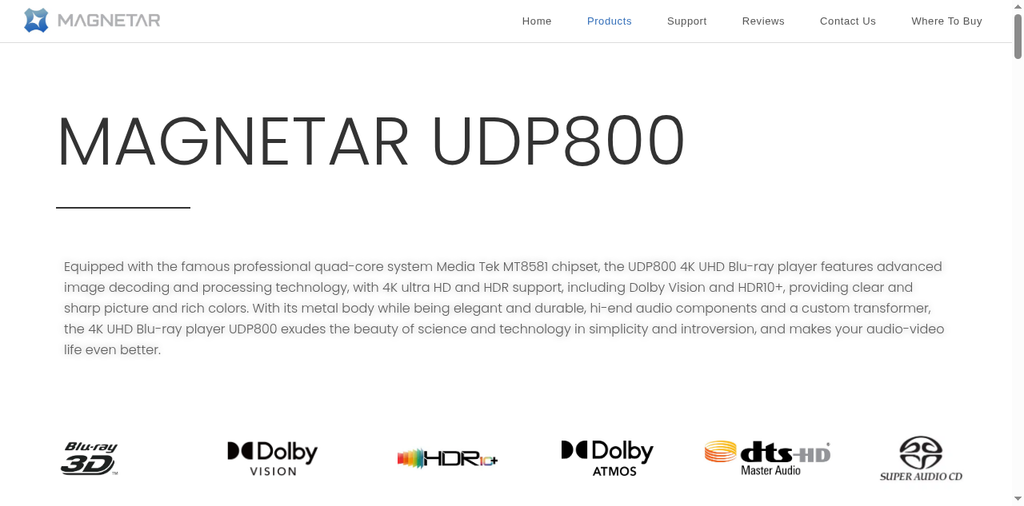
When the mainstream leaves a category, boutiques inherit it. Magnetar is what’s left at the top of the 4K Blu-ray player market, and the UDP800 is the entry point to that world.
Magnetar UDP800 official product page
It supports HDR10, HDR10+ and Dolby Vision with HDR-to-SDR conversion, runs a MediaTek MT8581 quad-core chip, and carries dual Burr-Brown PCM1795 DACs with both XLR balanced and RCA outputs. Disc support is the real selling point: UHD Blu-ray, BD3D, DVD, SACD, CD and DSD64/128. The MKII revisions announced at CEDIA Expo 2025 sit at roughly $1,800 to $1,900 at US dealers for the UDP800MKII, though that pricing is dealer-reported rather than published by Magnetar.
Who actually needs this? If you have a two-channel system with balanced inputs and a stack of SACDs, the analogue output stage is doing real work and the player is a genuine source component. If you’re feeding an AV receiver over HDMI and playing only films, you’re paying roughly three times the Panasonic’s price for a disc transport that outputs identical bits. Buy it for the DACs or don’t buy it.
Panasonic’s DP-UB9000 flagship still exists on paper, with dual HDMI, 7.1 analogue and balanced XLR stereo outputs. Check stock before you get attached to the idea.
Skip it if… the part a blu-ray player buying guide never tells you
We’d rather you keep the money. Skip buying a dedicated 4K Blu-ray player if any of these describe you.
- Your TV is HDR10-only and you own a disc console. A PS5 or Series X outputs HDR10 on discs, your TV takes HDR10, and a $550 player changes nothing you’d notice from the sofa. The upgrade you actually want is a better TV.
- You buy fewer than about six discs a year. At that rate, renting the occasional 4K stream costs less than the player, and you’re not building a collection worth protecting.
- You were about to buy a cheap player for a Dolby Vision TV. The DP-UB154P-K has no Dolby Vision. You’d spend $239.99 to get exactly the HDR10 your console already gives you. Spend a little more on the UBP-X700 or don’t bother.
- You need region-free playback. Retail Panasonic and Sony units sold in the US are region-locked, and going region-free means paying a third-party modifier a premium on top of a player that’s already scarce. Budget for that before you fall in love with import steelbooks.
- You’re buying because a list told you the DP-UB820-K is the best. It probably is, on merit. It was also sold out on Panasonic’s own store when we checked. Chasing an unavailable “best” while a perfectly good UBP-X700 sits in stock is how people end up with nothing.
Who should pick which: the use-case verdicts
Get the Panasonic DP-UB820-K if…
You own a Dolby Vision or HDR10+ TV, you care about tone mapping on a display that isn’t a $3,000 OLED, and you want the audio-only HDMI out for an older receiver. Accept that you’re shopping stock, not price, at $549.99 list.
Get the Sony UBP-X700 if…
You want the best 4K Blu-ray player for the money and you don’t own an HDR10+ TV. Dolby Vision, dual HDMI, full lossless audio bitstreaming, roughly $160 to $190 new as of August 2026. This is the default recommendation for most readers.
Get the Panasonic DP-UB154P-K if…
Your TV is HDR10 or HDR10+, you don’t own a disc console, and $239.99 is the ceiling. It plays your DVDs and standard Blu-rays too, which quietly matters if you have shelves of them.
Get a Magnetar if…
You have balanced XLR inputs, a serious two-channel system, and SACDs. Otherwise you’re buying a badge.
Use the console you already own if…
Your TV is HDR10-only, or you mostly watch on a screen where the difference is academic. You already have a competent UHD Blu-ray player sitting under the TV. The only thing you’re missing is Dolby Vision on discs, and on the wrong TV that’s nothing at all.
Buy used if…
You’re patient. This category has been shedding manufacturers since 2017, and the used market is full of well-kept players from people who moved to streaming and regretted nothing. A used UBP-X700 or a DP-UB820-K found second-hand is the smartest money in this whole article, provided you can test the disc tray before you pay.
Wrap up
The revival is real. Discs grew 12% in the US and 19.5% in the UK across 2025, steelbooks are shifting serious money, and the reason isn’t sentiment. It’s that a licence can expire on September 1 and a disc can’t.
The hardware is the problem. Two mainstream manufacturers left, a flagship showing Sold out at $549.99 on the maker’s own store, consoles that got $100 to $150 more expensive in 2026 and still won’t give you Dolby Vision on a disc. That’s the market you’re shopping.
So the practical version: if you already own a disc console and an HDR10 TV, buy discs and nothing else. If you want the best 4K Blu-ray player you can actually get delivered this week, it’s the Sony UBP-X700. If your TV does Dolby Vision or HDR10+ and you’re willing to hunt, the Panasonic DP-UB820-K is worth the chase. Prices and stock in this piece are an August 2026 snapshot and they move fast, so verify before you buy.
And buy the player while there’s still a player to buy. We keep testing what’s left in this category and where the honest value sits, and you’ll find the rest of our device and product reviews as we work through it.
Frequently asked questions
Do you need a 4K Blu-ray player to play 4K Blu-rays?
Yes. Ultra HD Blu-ray discs won’t play in a standard Blu-ray or DVD player; the drive and decoder are different hardware. You need a dedicated Ultra HD Blu-ray player or a compatible console: the disc-drive PS5, Xbox Series X, Xbox One X, or a non-All-Digital Xbox One S.
Will a 4K Blu-ray player play my older DVDs and Blu-rays?
Yes, all current 4K Blu-ray players are backwards compatible with standard Blu-ray, DVD and CD. Most also upscale that older material toward 4K, and Panasonic’s models use 4K Direct Chroma Upscaling for it. Region locking still applies to the older formats as well as the new ones.
Is it worth buying a true 4K Blu-ray player, or is upscaling good enough?
A true 4K Blu-ray player wins clearly. Upscaling invents detail; a UHD disc carries it natively at 50 GB to 100 GB and 72 to 144 Mbit/s, with HDR metadata and lossless audio no upscaler can reconstruct. If you’re buying 4K discs at all, buy hardware that plays them properly.
Does the PS5 support Dolby Vision?
No. The PS5 has no Dolby Vision support anywhere: not games, not streaming apps, not Ultra HD Blu-ray discs. It outputs HDR10 instead, and it doesn’t support HDR10+ either. If Dolby Vision on disc matters to you, you need a standalone player such as the Sony UBP-X700 or Panasonic DP-UB820-K.
Is the Xbox Series X a good 4K Blu-ray player?
It’s a competent one with one real limitation. The Series X plays Ultra HD Blu-ray properly and supports Dolby Vision for games and streaming apps, but it drops to HDR10 for disc playback. As a free player you already own, it’s fine. As a reason to buy a console in 2026, after the August 1 price increase, it isn’t.
Is 4K Blu-ray better than streaming?
Measurably, yes. Ultra HD Blu-ray runs 50 GB discs at 72 or 92 Mbit/s and 66 GB and 100 GB discs at up to 144 Mbit/s, far above any consumer streaming tier, and carries lossless Dolby TrueHD or DTS-HD Master Audio. The gap shows most in dark scenes, film grain and complex motion.
Is Blu-ray being phased out in 2026?
The players are thinning faster than the discs. Samsung, Oppo and LG have all exited the player market, leaving Panasonic and Sony plus boutiques like Magnetar. Disc sales, though, grew 12% in the US and 19.5% in the UK during 2025. Expect scarce hardware, not a dead format.
Do I need a special HDMI cable or receiver for 4K Blu-ray?
Every device in the chain needs HDMI 2.0 and HDCP 2.2 support, including your AV receiver or soundbar. An older receiver without HDCP 2.2 will block the picture entirely. That’s why players like the Panasonic DP-UB820-K include a second, audio-only HDMI output that bypasses the receiver for video.
Are 4K Blu-ray players region-free?
Not from the factory. US-market Panasonic and Sony players are locked to Blu-ray Region A and DVD Region 1. Region-free playback means buying a third-party modified unit, which costs more and complicates warranty support. Check region coding before importing discs, particularly for boutique-label releases from the UK or Japan.